11+ Vocabulary: How to Master Synonyms, Antonyms and Cloze Passages
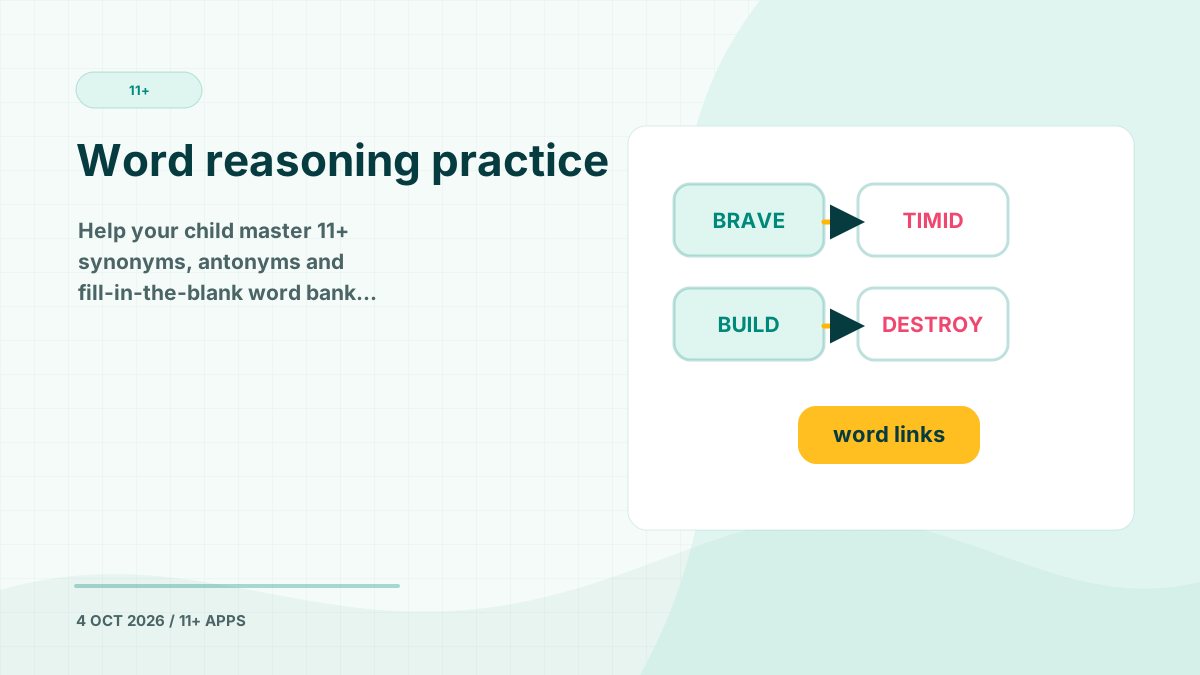
Help your child master 11+ synonyms, antonyms and fill-in-the-blank word bank questions with tutor-tested strategies, worked examples and a weekly routine.
Why Synonyms and Antonyms Matter in the 11+
Synonym and antonym questions are some of the most common vocabulary tasks in the 11+. They appear in English papers, in Verbal Reasoning and in the cloze (fill-in-the-blank) passages used by many grammar school tests. They look simple, but each one checks whether your child truly knows a word or has only seen it before.
The good news is that these questions reward steady, structured preparation. A child who learns words with care, who knows the meaning, the word class and a word with a similar or opposite meaning, will pick up marks quickly across several parts of the exam.
Did you know? Many 11+ cloze passages use a word bank where every word is used only once. Getting one blank wrong often causes a second mistake later, so careful elimination matters as much as word knowledge.
The Three Question Types to Prepare For
| Question Type | What Your Child Must Do | Example | Key Skill |
|---|---|---|---|
| Word bank cloze | Fill blanks in a passage using a given list of words | ”Jonathan embarked on an ___” → expedition | Context and word class |
| Synonyms | Choose the word closest in meaning | INSOLENT → rude | Precise definitions |
| Antonyms | Choose the word most opposite in meaning | FAMOUS → obscure | Definition plus reverse thinking |
Part 1: Tackling Word Bank Cloze Passages
A typical cloze passage tells a short story. In this example, a boy explores a forest on an autumn morning, and the word bank includes words such as expedition, canopy, grove, captivated, tranquil, flock, melody, sprawling, intricate, panoramic, gratitude and glow.
Step 1: Learn the Word Bank Before You Start
Go through every word and agree on its meaning before your child tries any blanks. For example:
- Expedition — a journey made by a group of people for a particular purpose
- Canopy — the top layer of branches and leaves that forms a roof over a forest
- Grove — a small wood or group of trees
- Nimble — quick and light in movement
- Captivated — having your attention and interest completely held
- Tranquil — calm and free from disturbance
- Sprawling — spreading out over a large area in an untidy, irregular way
- Intricate — very complicated or detailed
- Flock — the collective noun for a group of birds
Tip: Ask your child to keep a personal dictionary. Every time they meet a new word in a cloze passage, they write it down with its meaning and a sentence of their own. Revisiting this notebook is one of the quickest ways to make new words stick.
Step 2: Read the Whole Sentence and Identify the Word Class
Before choosing a word, your child should ask: does this blank need a noun, a verb or an adjective? In “he stumbled upon a ___ stream”, the blank sits before a noun, so an adjective is needed. That rules out flock, melody and expedition straight away and points towards tranquil.
Step 3: Do the Easy Blanks First
Some blanks are obvious. “The ___ leaves crunched beneath his feet” clearly needs fallen. “Their songs created a beautiful ___” needs melody. Filling these in first leaves fewer options for the harder blanks.
Step 4: Cross Off and Recheck
As each word is used, cross it off. If two words are left over at the end and neither fits, a mistake has been made earlier. Go back and test each answer again. Even experienced tutors get caught out by this, which shows how important checking is.
Tip: Words that look alike are a classic trap. Grove (a group of trees) and glow (a steady light) are easy to mix up when reading quickly. Encourage your child to say each option aloud in the sentence.
Part 2: Mastering Synonyms
With synonym questions, your child picks the word that means the same as a given word. The best approach is to define the word first, then look at the options.
| Word | Meaning | Synonym |
|---|---|---|
| Insolent | Rude and lacking respect | Rude |
| Articulate | Able to speak fluently and clearly | Eloquent |
| Superior | Higher in rank or status | Senior |
| Principled | Acting according to a strong sense of right and wrong | Moral |
| Conscientious | Wanting to do one’s work or duty well and thoroughly | Diligent |
| Discreet | Careful about what one says or does, so as to keep things private | Circumspect |
| Special | Distinguished from others of its kind | Particular |
Notice how many of these words describe character and behaviour. Examiners like these words because they also appear in comprehension texts and character-description questions. For a wider list of word pairs, see our guide to antonyms and synonyms for the 11+.
Part 3: Mastering Antonyms
Antonyms are harder because your child has to think in two steps: what does the word mean, and what is its opposite? If the first step is shaky, the second will fail.
| Word | Meaning | Antonym |
|---|---|---|
| Marine | Relating to the sea (salt water) | Freshwater |
| Surly | Bad-tempered and unfriendly | Pleasant |
| Personal | Belonging to one individual | Public |
| Rational | Based on reason and logic | Absurd |
| Needy | Lacking money or basic necessities | Affluent |
| Famous | Widely known | Obscure |
| Bold | Confident and willing to take risks | Timid |
| Guilty | Responsible for a crime or wrongdoing | Acquitted / innocent |
Tip: Watch out for context-specific opposites. The opposite of marine is not “land” in this case but freshwater, because both words describe water. Encourage your child to think about the topic the word belongs to.
Our article on 100 important antonyms in English is a useful bank of further practice pairs.
Common Mistakes to Avoid
- Guessing from the first letter or sound. Words that look alike often have very different meanings.
- Choosing a related word instead of a matching one. Journey and expedition are related, but they are not interchangeable in every sentence.
- Ignoring word class. A verb cannot fill an adjective-shaped gap, however good the meaning seems.
- Skipping the checking stage. In a word bank, one early error can cause another.
- Learning definitions without usage. A child who can use a word in a sentence will recognise it far more reliably under exam pressure.
A Simple Weekly Routine
| Day | Activity | Time |
|---|---|---|
| Monday | Learn 6—8 new words with definitions | 15 mins |
| Tuesday | Find a synonym for each new word | 10 mins |
| Wednesday | Find an antonym for each word (where one exists) | 10 mins |
| Thursday | Complete a short word bank cloze passage | 15 mins |
| Friday | Mixed quiz on this week’s and last week’s words | 10 mins |
| Weekend | Reading for pleasure; spot new words for next week | 20+ mins |
For more ideas on building word knowledge over time, read our guide to building vocabulary for the 11+ English exam.
Practise with 11+ Apps
Synonyms, antonyms and cloze passages all come down to secure, well-practised word knowledge, and that is what our apps are built for.
The 11+ Vocabulary Builder has 1,600 questions across 20 topics, including synonyms, antonyms, homophones, idioms, prefixes and suffixes, collocations, contextual meaning and shades of meaning. Each topic comes with worked study notes. It suits the daily 10 to 15 minute sessions that turn new words into words your child really knows.
The 11+ English Practice Papers app has 600 questions across 12 practice papers, covering comprehension, spelling, punctuation and vocabulary in context. It lets your child practise these skills in the same mixed format they will meet on exam day.
Both apps are part of our full suite of 8,100+ questions across 7 specialist 11+ apps, covering English, Maths, Verbal Reasoning and Non-Verbal Reasoning, so your child can prepare for every part of the exam in one place.
Frequently Asked Questions
What is the difference between a synonym and an antonym in the 11+?
How do I help my child with word bank fill-in-the-blank questions?
Why does my child find antonym questions harder than synonym questions?
Which words come up most often in 11+ synonym and antonym questions?
How long should my child spend on vocabulary practice each day?
Related Apps
Start Practising Today
Download our 11+ exam preparation apps and study with 8,190+ practice questions, mock exams, and detailed explanations.