Antonyms: Building Vocabulary Through Opposites for the 11+
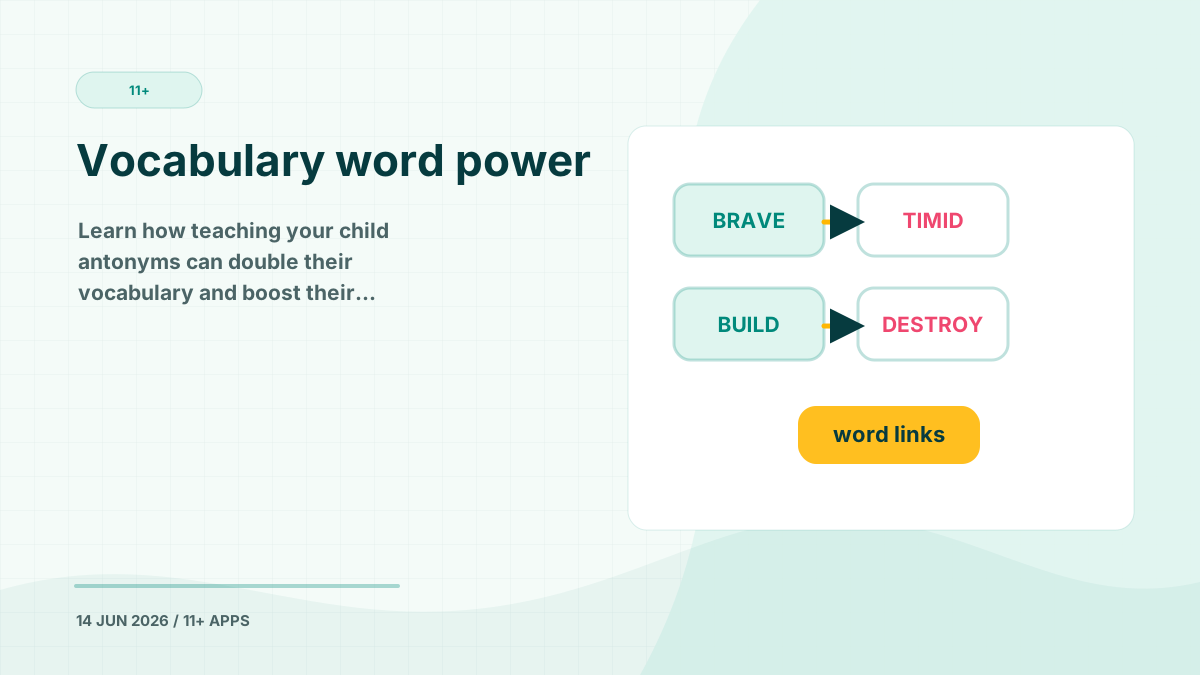
Teaching your child antonyms can double their vocabulary and boost 11+ English and Verbal Reasoning scores, with practical word lists and study routines.
Why Antonyms Deserve a Place in Your 11+ Plan
Ask a child to name the opposite of happy and most will answer sad without hesitation. Ask for the opposite of humble, erratic, or credulous, and you quickly see where vocabulary gaps appear. Antonyms — words with opposite meanings — are one of the most efficient ways to grow your child’s word knowledge, and they show up directly in the 11+ exam.
The cleverest thing about learning antonyms is that it effectively doubles your child’s vocabulary. Every new word your child meets comes with an opposite, and learning the pair together means two words gained for the effort of one. Better still, the contrast between a word and its opposite gives each one a clear anchor, making both easier to recall under exam pressure.
Did you know? Many 11+ Verbal Reasoning papers contain dedicated “opposite” question types, where a child must select the word most opposite in meaning to a given word. A child who has practised antonyms systematically has a real advantage here.
Where Antonyms Appear in the 11+
Antonyms are not confined to a single question type. They influence performance across several parts of the exam:
- Verbal Reasoning opposites — choosing the word most opposite in meaning from a list of options.
- Synonyms and antonyms together — questions that test whether a child can distinguish “same meaning” from “opposite meaning”.
- Comprehension — understanding tone and contrast in a passage often hinges on recognising opposing ideas.
- Vocabulary in context — selecting the right word to complete a sentence frequently requires knowing what doesn’t fit.
- Writing tasks — children with a richer store of opposites write with more precision and variety.
For a closer look at how these word-knowledge questions are marked and structured, our guide to Antonyms and Synonyms for the 11+ Vocabulary Section is a useful companion to this post.
Antonyms by Difficulty: A Worked Word List
One helpful way to stretch a child is to introduce antonym pairs in tiers, starting with accessible everyday words and progressing to the more sophisticated vocabulary that distinguishes top scorers. The table below shows a selection of pairs grouped by difficulty.
| Word | Antonym | Difficulty |
|---|---|---|
| cheerful | grumpy | Foundation |
| brave | cowardly | Foundation |
| generous | selfish | Foundation |
| proud | humble | Foundation |
| calm | frenzied / agitated | Intermediate |
| honest | dishonest / deceptive | Intermediate |
| modest | arrogant / pretentious | Intermediate |
| temporary | permanent / enduring | Intermediate |
| resilient | vulnerable | Advanced |
| coherent | disjointed | Advanced |
| tangible | abstract | Advanced |
| erratic | consistent / predictable | Advanced |
Notice that many words have more than one antonym. The opposite of calm might be frenzied or agitated depending on the sentence, and modest contrasts with both arrogant and pretentious. Teaching your child that opposites can be shaded in different ways builds the kind of nuanced understanding that the hardest 11+ questions reward.
Tip: When your child meets a new word, ask them not just “what does this mean?” but “what would be its opposite?” This simple habit turns every new word into a pair and reinforces both halves at once.
Six Ways to Help Your Child Master Antonyms
1. Learn Words in Pairs
Whenever your child records a new word, ask them to write its opposite alongside it. A vocabulary journal organised as two columns — word and antonym — makes revision faster and reinforces the link between them. This pairing also primes your child for the exact format many Verbal Reasoning questions use.
2. Read Widely and Spot the Contrasts
Reading remains the most natural way to absorb vocabulary. Encourage your child to notice when an author sets two ideas against each other — a cheerful character beside a grumpy one, a generous act following a selfish one. Discussing these contrasts brings antonyms to life far better than a list ever could. Our guide to Building Vocabulary for the 11+ English Exam sets out a wider reading routine to build on.
3. Use Flash Cards
Flash cards are ideal for antonyms because they have a built-in question-and-answer shape: word on the front, opposite on the back. Short, daily sessions of five to ten minutes are far more effective than occasional long ones, and they suit the way young children commit words to long-term memory.
4. Practise Thinking of the Opposite First
In an exam, encourage your child to think of the answer before reading the options. If the question asks for the opposite of eager, a child who has already thought of apathetic or indifferent will spot it instantly, rather than being led astray by a tempting wrong answer.
5. Play Opposite Games
Make it fun. On a car journey, take turns calling out a word and racing to name its opposite. Over dinner, challenge your child to find the most unusual antonym they can for a common word. Games like this keep vocabulary active without ever feeling like homework.
6. Use New Words in Conversation
A word is only truly learned when a child can use it confidently. Encourage your child to slip a newly learned antonym into conversation or writing during the week. Active use turns passive recognition into lasting knowledge — and that is what survives until exam day.
A Simple Weekly Antonym Routine
Consistency beats intensity. A short, predictable routine across the week embeds far more than an occasional cramming session.
| Day | Activity | Time |
|---|---|---|
| Monday | Introduce 5 new antonym pairs with meanings and examples | 15 mins |
| Tuesday | Write a sentence using each new word and its opposite | 10 mins |
| Wednesday | Flash card review of this week’s and last week’s pairs | 10 mins |
| Thursday | Verbal Reasoning “opposite” practice questions | 10 mins |
| Friday | Quiz or opposite game to test the week’s pairs | 15 mins |
| Weekend | Free reading, spotting contrasts in the text | 20+ mins |
Tip: At the end of each week, ask your child to pick their three favourite new pairs and use them aloud over the weekend. Reviewing in this active, low-pressure way dramatically improves retention.
Building Word Power with Our 11+ Apps
Structured practice is what turns scattered word knowledge into reliable exam marks. Our 11+ Vocabulary Builder app is the natural home for antonym practice, with 1,600 questions across 20 topics — including antonyms, synonyms, homophones, idioms, prefixes and suffixes, shades of meaning, and contextual meaning — each backed by worked study notes that explain why an answer is correct.
To see this vocabulary working inside full exam-style passages, the 11+ English Practice Papers app offers 600 questions across 12 practice papers, testing comprehension, spelling, punctuation, and vocabulary in context — exactly the conditions in which antonym knowledge pays off. For children focusing on the reasoning side, our guide to Key Verbal Reasoning Methods Every Child Should Know shows how word knowledge underpins many question types.
Together, our seven specialist apps offer over 8,100 questions spanning English, Maths, Verbal Reasoning, and Non-Verbal Reasoning — a complete, structured path through every part of the 11+. Start with antonyms, stay consistent, and watch your child’s vocabulary — and confidence — grow week by week.
Frequently Asked Questions
What is an antonym and why does it matter for the 11+?
How can learning antonyms double my child's vocabulary?
How many antonym pairs should my child learn each week?
What is the best way to practise antonyms for the 11+?
Related Apps
Start Practising Today
Download our 11+ exam preparation apps and study with 8,190+ practice questions, mock exams, and detailed explanations.