11+ Verbal Reasoning Type 5: How to Create a Compound Word
Learn how to solve 11+ compound word questions: a step-by-step method, common spelling traps, and practice tips to help your child score full marks.
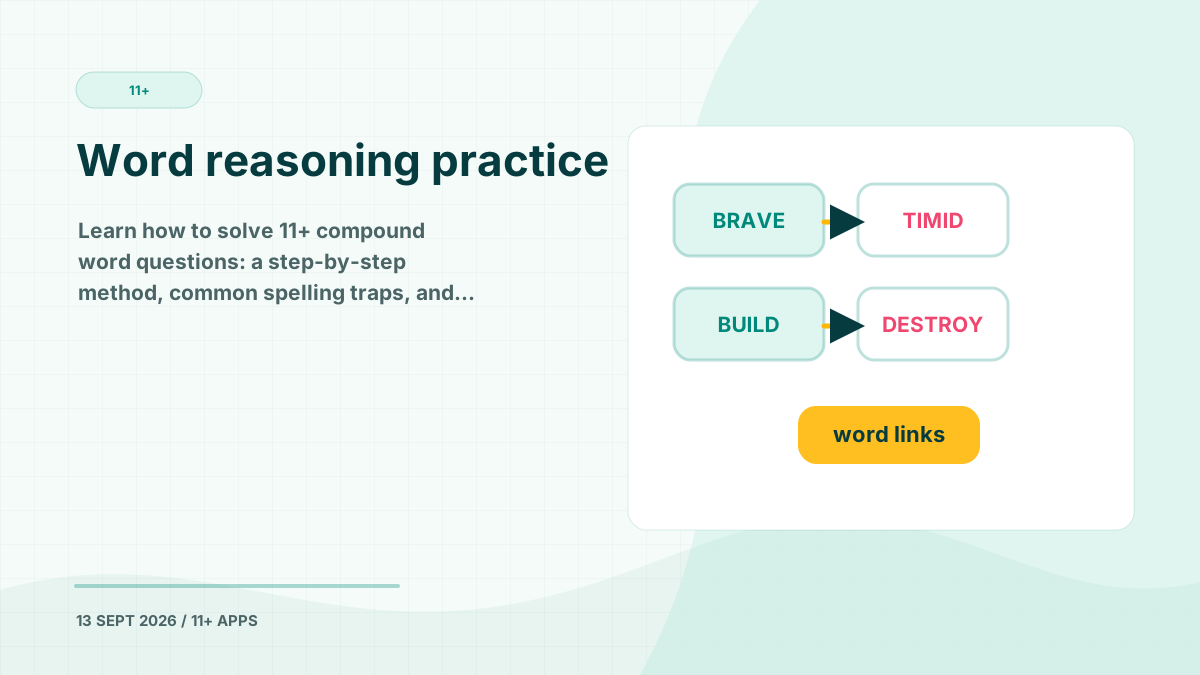
What Is a Compound Word Question?
Compound word questions come up often in 11+ verbal reasoning papers, especially GL Assessment-style tests. Your child sees two groups of three words. They have to pick one word from each group that joins together to make a single, real word.
Here is the example used throughout this guide:
(lips, rob, red) (bust, stick, raw)
The word from the first group always comes first. So your child is looking for a real word made of one word from the left, followed straight away by one word from the right.
The answer is red + raw = redraw, meaning to draw something again. On the way there, though, there are two traps that catch many children. We look at both below.
Did you know? Each question has only nine possible combinations (three words × three words). Because the number is so small, a careful, systematic check is fast and reliable.
The Step-by-Step Method
The best approach is to work through the combinations in order, so nothing gets missed.
- Take the first word in the left-hand group and try it with each of the three words on the right.
- Say each combination in your head. Does it sound like a real word?
- Check the spelling. Picture the joined word or write it down. Is that how it is really spelt?
- If none work, move to the next word on the left and repeat.
- Once you are completely sure you have the answer, stop. You do not need to check the remaining pairs.
Working Through Our Example
| Combination | Sounds Like a Word? | Correct Spelling? | Valid? |
|---|---|---|---|
| lips + bust = lipsbust | No | — | ✗ |
| lips + stick = lipsstick | Yes (“lipstick”) | No: lipstick has only one S | ✗ |
| lips + raw = lipsraw | No | — | ✗ |
| rob + bust = robbust | Yes (“robust”) | No: robust has only one B | ✗ |
| rob + stick = robstick | No | — | ✗ |
| rob + raw = robraw | No | — | ✗ |
| red + bust = redbust | No | — | ✗ |
| red + stick = redstick | No | — | ✗ |
| red + raw = redraw | Yes | Yes | ✓ |
Look at the two near-misses. Lipstick and robust are both real words, and a child in a hurry could easily pick either one. Written out in full, though, “lipsstick” has two S’s and “robbust” has two B’s. Neither is a correct spelling, so neither can be the answer.
Tip: When a combination sounds right, ask your child to spell it out loud letter by letter. Examiners set these near-misses on purpose to catch children who rely on sound alone.
The Three Big Traps
1. The Spelling Trap
This is the trap from our example. When two words join, their letters must match the real word exactly, with no extra or missing letters. Double letters in the middle of the joined word are the usual culprit, so train your child to check the join closely.
2. The Pronunciation Trap
Joining two words can change how they sound. In our example, “red” and “raw” said separately sound quite different from redraw. Some children read the pair as “red-raw” and dismiss it, but said as one word it clearly makes sense. Other examples:
- hat + red = hatred
- not + ice = notice
- pal + ace = palace
None of these sounds like its two parts said separately. If a pair looks promising on paper, try saying it as one smooth word.
3. The Meaning Trap
Many children assume the new word must mean something connected to its two parts, as with football or sunflower. In the 11+, the answer is often a word whose meaning has nothing to do with its parts. For instance, from (sit, bar, mud) (gain, lock, rope), the answer is bar + gain = bargain. That has nothing to do with bars or gaining.
Common Compound Word Building Blocks
Some short words turn up again and again in these questions. Knowing them helps your child spot answers quickly.
| First Word | Second Word | New Word |
|---|---|---|
| car | pet | carpet |
| car | rot | carrot |
| ten | ant | tenant |
| war | den | warden |
| for | get | forget |
| tar | get | target |
| leg | end | legend |
| pat | tern | pattern |
| man | age | manage |
| pass | age | passage |
| king | dom | kingdom |
| bar | gain | bargain |
Notice how often endings such as -age, -get, -den and -dom appear. Make a game of it: give your child a short word such as “man”, “car” or “for” and see how many longer words they can build from it.
Tip: Keep a “compound word bank” in the back of a vocabulary notebook. Every time your child finds a surprising compound (like hatred or tenant), add it to the list. Our guide to building vocabulary for the 11+ has more ideas for making new words stick.
Speed vs Accuracy: Finding the Balance
The systematic method is thorough, but in a timed paper your child cannot spend too long on any one question. Here is how to balance the two:
- Scan first. Often the answer stands out within a few seconds. If your child is 100% certain, they should mark it and move on.
- Check systematically only when unsure. If nothing jumps out, work through the nine pairs in order.
- Note possible answers as you go. If a pair might be a word, jot it in the margin. That way your child does not lose track, and can come back to it if nothing better turns up.
- Never leave it blank. If time is short, choose the most likely candidate from their notes.
A Simple Practice Plan
| Week | Focus | Activity |
|---|---|---|
| Week 1 | Learn the method | 10 questions a session, checking all nine pairs every time |
| Week 2 | Spot the traps | Look out for double-letter spellings and sound changes |
| Week 3 | Build speed | Timed sets of 10 questions, aiming for under 30 seconds each |
| Week 4 | Mixed practice | Compound words mixed with other verbal reasoning types |
Compound words work well alongside other word-building question types. Once your child is comfortable, try the related “find the word that goes with both pairs” questions in our Type 16 guide. Our overview of key verbal reasoning methods shows how this type fits into the wider exam.
Practise Compound Words with 11+ Apps
Compound word questions come down to three habits: check every pair, check the spelling, and say the word as one. Regular, varied practice turns these habits into instinct, and that is where our apps help.
- The 11+ Verbal Reasoning Methods & Techniques app teaches the methods behind each question type. It has 1,050 questions and detailed study notes across 22 topics, including word codes, letter series and analogies, so your child learns how to approach each type before tackling it under exam conditions.
- The 11+ Verbal Reasoning Practice Papers app puts those skills to the test with 1,920 questions across 24 practice papers. They cover analogies, comprehension, letter series, number series and word puzzles, in a format that mirrors the real exam.
Together with the rest of our suite (8,100+ questions across 7 specialist 11+ apps covering verbal reasoning, non-verbal reasoning, maths, English and vocabulary), your child gets structured, exam-focused practice in every area. A few minutes a day on compound words, and the traps in the example above will soon stop catching them.
Frequently Asked Questions
What is a compound word question in the 11+ verbal reasoning exam?
How can my child get faster at compound word questions?
Why does my child keep getting compound word questions wrong when the answer sounds right?
Does the new word have to mean something related to the two smaller words?
How often should my child practise compound word questions before the 11+?
Related Apps
Start Practising Today
Download our 11+ exam preparation apps and study with 8,190+ practice questions, mock exams, and detailed explanations.