
📖Definition
In these questions you'll be given a series of numbers that follow a pattern. Your task is to find the next number in the series.
✏️Example
17, 14, 11, 8, 5, ( ? )
Knowledge Required
You need good mental arithmetic skills and an ability to spot patterns. Know your square numbers as these crop up from time to time.
✅How To Answer
Always start with Method 1. If no obvious pattern emerges, move on to Method 2.
Method 1
Write down the difference between each consecutive pair of numbers in the series.
Diagram

Each number is 3 less than the previous one so the missing number is 5 - 3 = 2
✏️Example
11, 10, 10, 11, 13, 16, ( ? )
As before, write down the difference between each consecutive pair of numbers in the series.
Diagram

Can you see what's happening here? The differences between the numbers are -1, 0, +1, +2, +3,
They're increasing by 1 in each case so the next difference will be +4 making the next number in the sequence 16 + 4 = 20.
✏️Example
1, 2, 3, 5, 8, 13, ( ? )
As usual, write down the differences between each pair of consecutive numbers.
Diagram

Here, from the third number onwards, each term is formed by adding the previous two together. The next term will be 8 + 13 = 21.
You're likely to get at least one series of this type so watch out for them.
✏️Example
96, 48, 24, 12, 6, ( ? )
Do the usual...
Diagram

Do you see the pattern here? Each time, we subtract half the current number. That is, we divide the current number by 2. So, we can write the series:
Diagram

and the next number will be 6 ÷ 2 = 3
You might also get a series where each number is multiplied by another number to produce the next term.
For example, in the series: 1, 2, 4, 8, 16, ( ? )
each new term is formed by multiplying the previous one by 2.
✏️Example
2, 3, 7, 16, 32, 57, ( ? )
Calculate the differences:
Diagram

Remember what we said above about knowing your square numbers? Here, they are the differences between each pair of consecutive numbers in the series.
1 = 1², 4 = 2², 9 = 3², 16 = 4², 25 = 5², so the next difference will be 6² = 36 and the next term will be 57 + 36 = 93.
✏️Example
3, 4, 7, 6, 11, 8, ( ? )
Already this looks a bit odd. The numbers are going up and down. Let's take a look at the differences between each pair of consecutive numbers.
Diagram

There's no pattern there. It's time to use Method 2.
Method 2
Treat the series as two alternating series.
Diagram
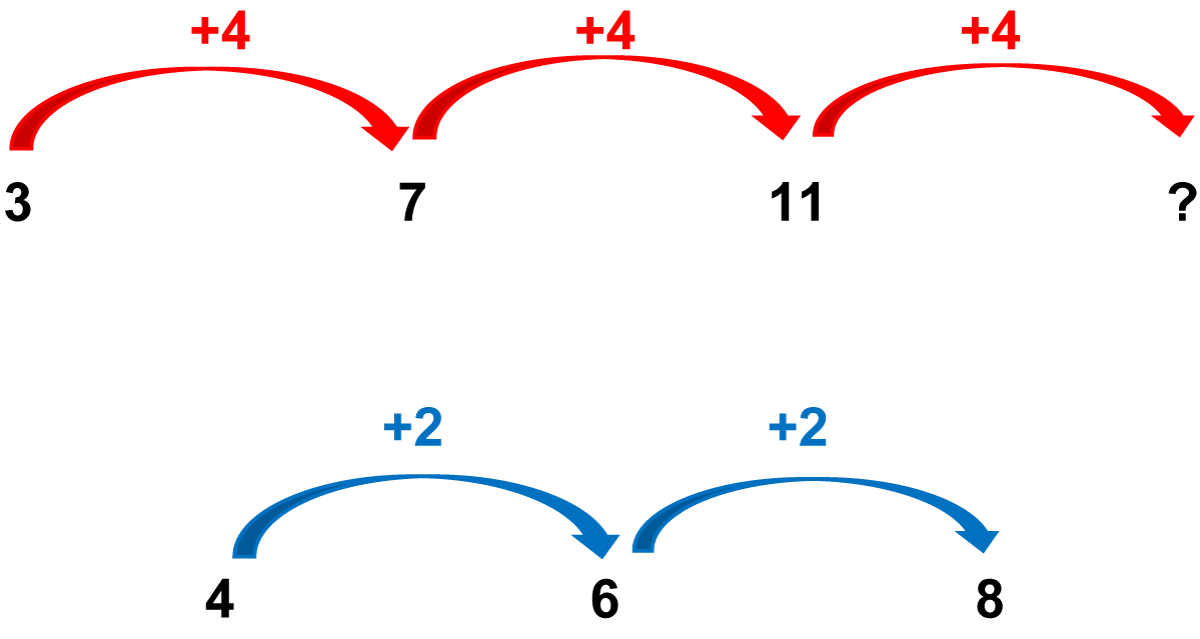
And relax! Normal service is resumed. You can see that there are actually two series here, one in which the difference is +4 and the other in which it's +2.
You can probably also see that you don't actually need to work out the second series as the missing term is part of the first series.
The missing number is 11 + 4 = 15.
Variances
The examples above cover all the variations you're likely to see. Learn how each type works and how to spot them.