📖Definition
In these questions you're given five pairs of letters that form a sequence. You have to find the next pair in the sequence.
✏️Example
EC CD AE YF WG ( ?? )
Knowledge Required
This is another type of question where you to know your alphabet inside out.
You'll have to count accurately in either direction along the alphabet and through each end of the alphabet.
You'll be given an alphabet like this.
Diagram

But, as you'll probably have to count through the end/beginning of the alphabet, it's good to be able to visualise it as a circle.
Diagram
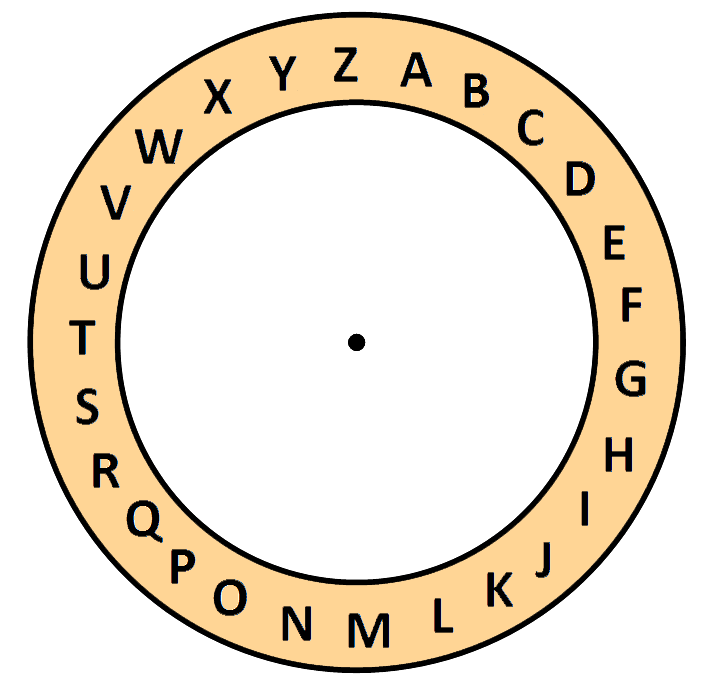
In the exam, you don't need to write the whole of the alphabet out in a circle, just write the letters near the beginning and the end, for example, V W X Y Z A B C D E
✅How To Answer
The letters in each individual pair aren't related at all so you don't need to worry about that. What you do need to be concerned about is the pattern made by the first letters of each pair and the pattern made by the second letters of each pair.
Let's look at the first letters in each pair and see how they're related.
Diagram
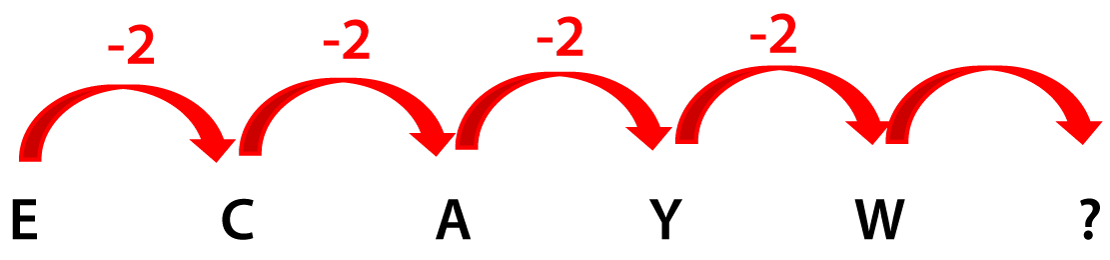
Count how many steps forward/back each letter moves. Here, each letter moves back 2 so the missing letter will be 2 back from W ie. U.
Now do the same for the second letters in each pair.
Diagram

Here each letter moves forward by 1. So the missing letter will be on forward from G, ie. H so the answer is UH
💡Tips/hints
If you're looking at the first letters of each pair and you find that the number of steps between the first two letters in the series is the same as between the second two letters then you don't need to check the remaining letters. The pattern will be a fixed number of steps as it is in the example above.
OK, that was as easy as they come. Most of the time, the number of steps between the letters isn't constant but follows a pattern. In the example below, you'll see the other types of pattern that occur in these questions.
✏️Example
FF CI DK AL BL ( ?? )
Take the same approach as before. Consider the first letters of each pair.
Diagram
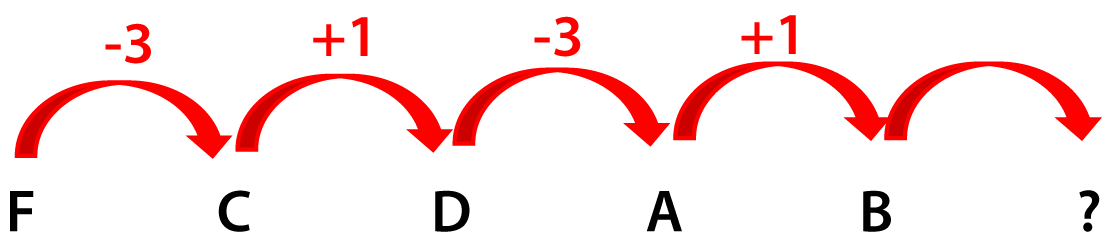
You can see that the moves between letters alternate between 3 back and 1 forward. So, following the pattern the first letter of the missing pair will be 3 back from B which is Y.
Now look at the second letters in each pair.
Diagram

You'll see that the moves decrease by 1 each time. So, the second letter in the missing pair will be -1 away from L ie. K making our answer YK.
Variances
The two examples above cover all the variations you're likely to see. Learn each type so you can easily spot them in the exam.
💡Multiple Choice Tip
If you're pushed for time, try and work out at least what the first letter of the missing pair should be. That will enable you to eliminate some of the wrong answers and increase your chance of guessing correctly.