📖Definition
Units of Length, Area and Volume are related.
Length is used to measure 1 dimensional objects ie. lines
Area is used to measure 2 dimensional objects ie. plane shapes
Volume is used to measure 3 dimensional object ie. solids.
Metric System
The Metric System is based on the decimal system which is good news.
The basic units of the metric system are as follows:
Diagram

💡Tips/hints
Make sure you have a basic idea of how big some of the base units are as you might be asked to give an estimate for the size of an object.
Try and relate units to everyday objects for example, a 1 litre bottle of squash or a 1kg bag of sugar.
Other helpful reminders are:
A football pitch is about 100m long
An average man is just under 2m tall.
A can of beans weighs about 500g
Your finger is about 1cm wide.
Reading Measurements
We Read Measurements all the time, measurements of distance, weight, speed, time, temperature etc.
Method
The key thing is to understand the scale. How much does each mark represent?
Not each mark has a number by it so find two that have numbers, A and B say. Now count the number of divisions between A and B, n say.
Then, each division represents (B-A)/n.
Sometimes there are no divisions. In this case, you have to judge it by eye. You can always pencil your own divisions in to make a measurement easier to read.
✏️Example
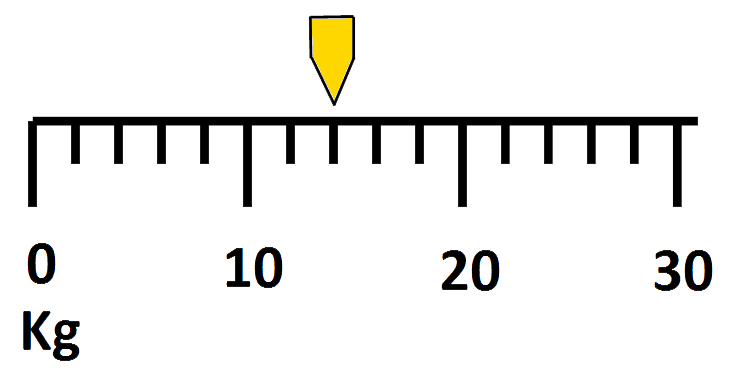
What weight is indicated on the scales below?
Diagram
✅Solution
The section between 0kg and 10kg is divided into 5. So, each mark represents (10kg - 0kg)/5 = 2kg.
The yellow marker is pointing to 2 divisions more than 10kg so that's 10kg + 2x2kg = 14kg.