📖Definition
A 2D shape can be symmetrical about a line or it can be symmetrical about a point of rotation.
Lines of Symmetry
A Line of Symmetry is a line that divides a shape into two halves, each of which is the mirror image of the other.
Diagram
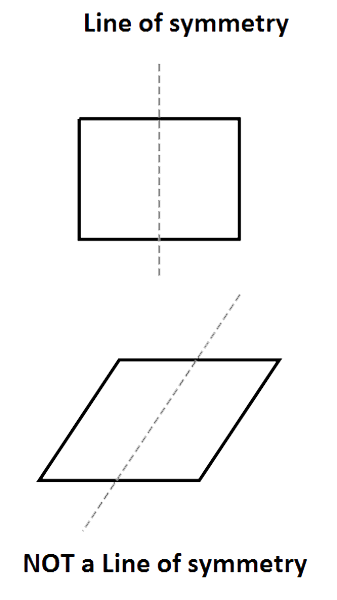
The line through the rectangle divides it in half, each half being a mirror image of the other. So, it's a Line of Symmetry.
The line through the parallelogram divides it in half but, although the halves are identical shapes, they are NOT mirror images of each other. So, this is NOT a Line of Symmetry.
Rotational Symmetry
If a two-dimensional shape can be rotated about a point and look exactly the same in the new position then it has Rotational Symmetry.
Diagram
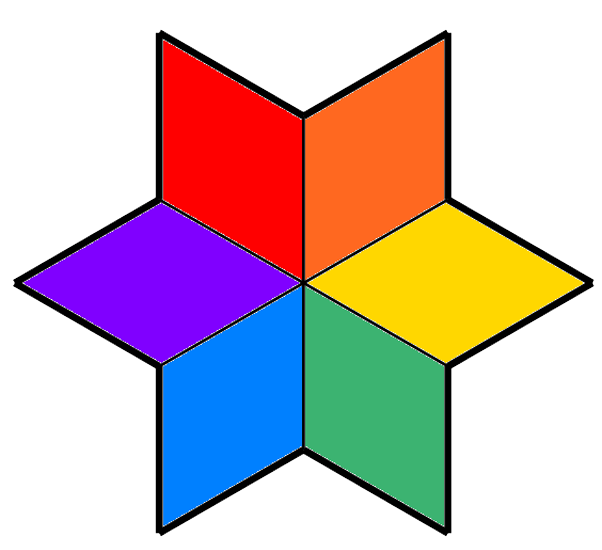
Ignoring colour, the star above has Rotational Symmetry of order 6. That means, that, starting at one position, (as shown) we can turn it to 5 more positions (turn it clockwise about the centre so that purple replaces red, then blue replaces purple etc) that fill the same space. So, including the first position, there are 6 different rotations that fill the same space.
💡Tips/hints
Don't forget to look for diagonal Lines of Symmetry.
The number of Lines of Symmetry of a regular polygon is equal to the number of sides of the polygon.
The Order of Rotational Symmetry of a regular polygon is the same as its number of sides.
Transformations
Shapes can be Transformed in a number of ways. Here we'll look at Translations, Rotations and Reflections.
Translation
A Translation moves the shape.
It doesn't turn it or reflect it simply shifts it to another position.
Diagram
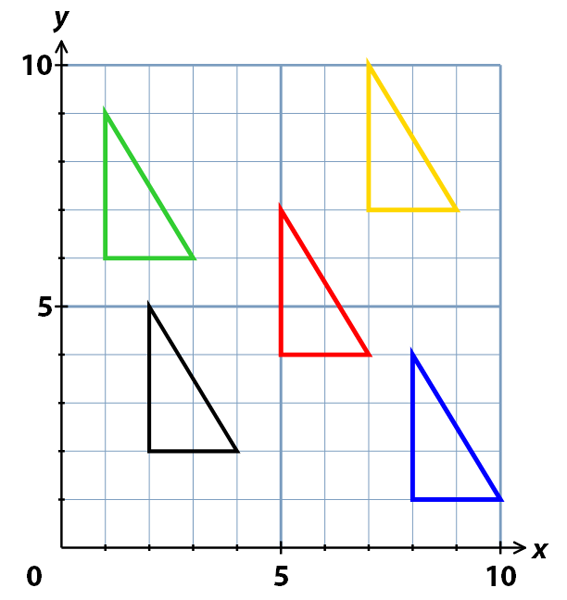
In the diagram, each triangle is a translation of each of the others.
For example, if the Red triangle is moved 2 to the right and 3 up, it becomes the Yellow triangle.
Reflection
A Reflection reflects the shape.
It doesn't change its size but reflects it in a Mirror Line
Diagram
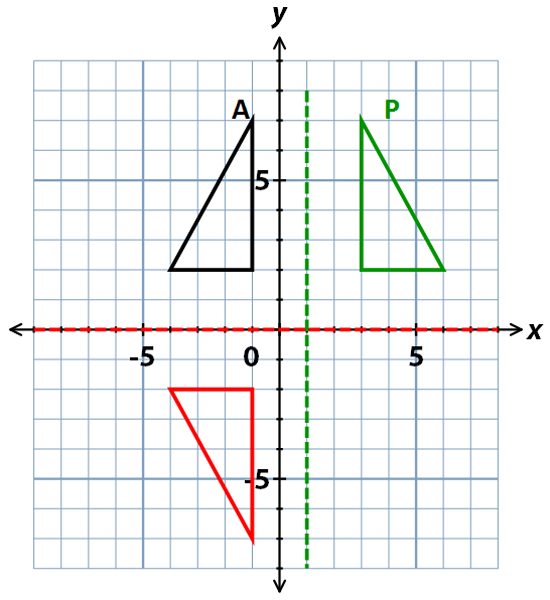
In the diagram, the Black triangle has been reflected in 2 different Mirror Lines
The Red triangle is its reflection in the Red mirror line.
The Green triangle is its reflection in the green mirror line.
Each point on the black triangle is the same distance from the mirror line as the equivalent point on the reflected triangle.
For example, on the black triangle, A, the top of the triangles, is 2 away from the green mirror line. And on the green reflection, the top of the triangle P is also 2 away from the mirror line.
Rotation
A Rotation rotates (turns) a shape about a point.
It doesn't change its size and it doesn't reflect it.
It just turns it.
Diagram
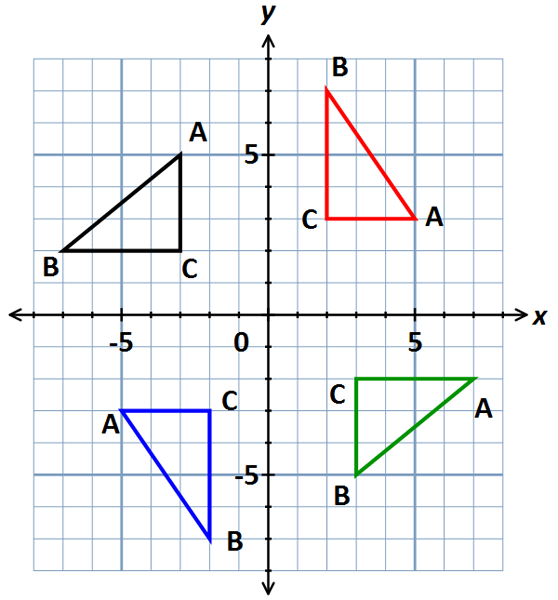
The Black triangle has been rotated Clockwise about the point (0,0) through 90° to create the Red triangle.
The Blue triangle has been rotated Anti-clockwise about the point (0,0) through 90° to create the Green triangle.
✏️Example
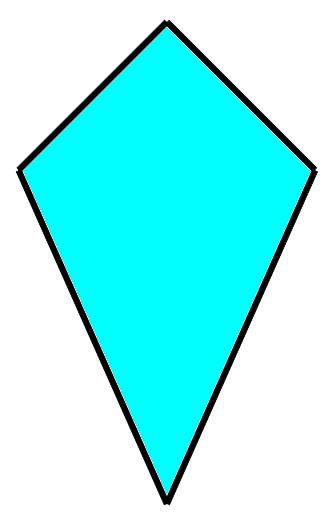
How many lines of symmetry does the shape below have?
Diagram
✅Solution
It just has one, the vertical line that divides it in two.
✏️Example
Archie has drawn this blue triangle on a coordinate grid. He draws its reflection using the green line as the mirror line. What are the coordinates of A in the reflected shape?
Diagram
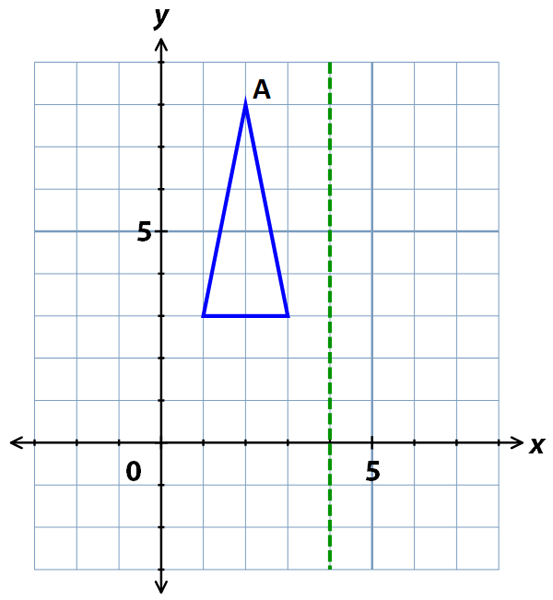
In the reflection, A will be the same distance from the mirror line as it is in the original triangle.
In the original, it's 2 to the left of the mirror line so in the reflection it will be 2 to the right. So, its x coordinate in the reflection will be 6. Its y coordinate remains the same ie. 8 so the answer is (6, 8)