📖Definition
The Probability of something happening is basically the Chance of it happening.
Some things are certain to happen and some things are certain NOT to happen. Other things lie somewhere in between these two extremes.
All Probabilities are between 0 and 1.
If something has a Probability of 0, it means it will never happen.
If something has a Probability of 1, it means it definitely will happen.
The Probability Scale runs from 0 to 1.
Diagram
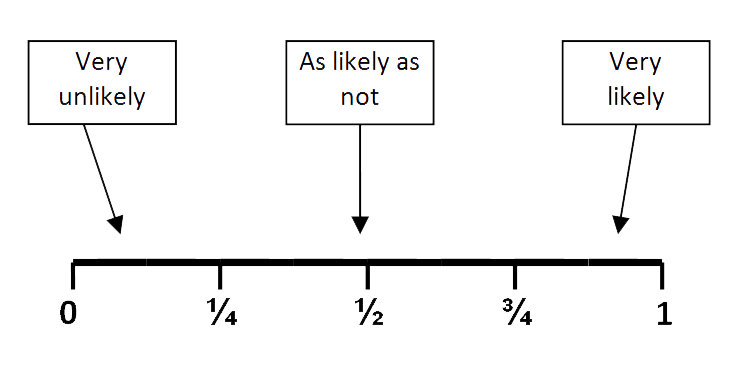
The Probability Scale is basically a number line running from 0 to 1. The closer an event is to 0, the less likely it is to happen. The closer it is to 1, the more likely it is to happen.
In the middle, with probability = 1/2, it's got the same chance of happening as not happening.
The sum of probabilities for all possible outcomes is always 1.
So, when if you toss a coin, it's as likely that it will be heads as tails so:
Probability heads = Probability tails = 1/2
The only possible outcomes are heads or tails so adding the probabilities of all the possible outcomes, we get 1/2 + 1/2 = 1
Method
Probabilities can be expressed as fractions or decimals (or sometimes percentages).
When writing a probability as a fraction, the denominator (bottom) is the number of all the possible things that can happen. The numerator (top) is the number of ways the thing we're interested can happen.
So, imagine throwing a dice. We want to know the Probability of throwing a 3.
There are 6 possible outcomes. That's the denominator of our fraction.
Out of those, only one is a 3 so our numerator is 1.
So, Probability of throwing a 3 on a dice is 1/6.
✏️Example
Put these events in order of their probability of happening starting with the most likely first:
A tossed coin lands heads up
A random card picked from a deck is an Ace
A dice is tossed and the number is 2 or greater
✅Solution
Let's look at each in turn.
The chance of a coin landing heads up is 1/2 (there are two outcomes and both are equally likely to happen)
In a deck, there are 52 cards in total, but only 4 of them are Aces so there's only a 4/52 chance of picking an ace.
On a dice, there are the numbers 1 - 6 so, 5 of those outcomes are 2 or greater. So, the chance of rolling a number 2 or greater is 5/6
So, in order of happening with the most likely first we have:
A dice is tossed and the number is 2 or greater
A tossed coin lands heads up
A random card picked from a deck is an Ace