📖Definition
You already know some Number Sequences:
Odd Numbers: 1, 3, 5, 7, 9, 11, ...
Even Numbers: 2, 4, 6, 8, 10, 12, ...
Prime Numbers: 2, 3, 5, 7, 11, 13, ...
Square Numbers: 1, 4, 9, 16, 25, 36, ...
Other Number Sequences are formed by following certain rules.
For example: Each number in a sequence is formed by adding 2 to the previous number and then doubling it. The first number in the sequence is 3.
So, to get the second, we add 2 to 3 to get 5 and then double it to get 10. The next number will be (2 + 10) x 2 = 24 and so on.
Method
If you're given a sequence, to find the rule for it you'll have to do some detective work and look for patterns.
Can you see certain numbers occurring on a regular basis? Is there a link between a number and the one before it or after it?
A common pattern is the difference between each number and the previous one is the same.
So, work out the difference between each number and the previous one in the sequence.
Once you've worked out the pattern, you can work out new numbers in the sequence.
Sometimes the sequence won't be numbers but a series of shapes. Do the same as above. First, count the elements in each shape and then try and work out a pattern for the numbers.
✏️Example
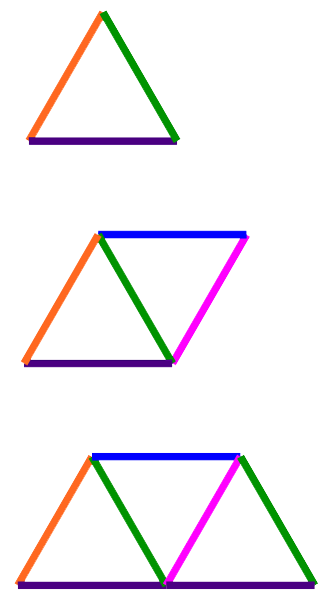
Coloured matchsticks are used to make a series of triangles. How many matchsticks will be needed to make the 5th pattern in the sequence?
Diagram
✅Solution
First, work out how many matchsticks at each stage.
1 triangle = 3 matchsticks
2 triangles = 5 matchsticks
3 triangles = 7 matchsticks.
Can you see the pattern? Each triangle added requires an extra 2 matchsticks.
So, the 4th triangle will need 7 + 2 = 9 and the 5th, 9 + 2 = 11 matchsticks.