📖Definition
A Fraction is a Part of a Whole Number. It has two parts, a top (numerator) and a bottom (denominator).
3/4 is a fraction. 3 is the numerator, 4 is the denominator.
The denominator, bottom, tells you how many parts something is divided into, in this case 4.
The numerator, tells you how many of those parts there are, in this case, 3.
Method
Numbers and Shapes can be split into Fractions.
Fraction of a Number
A fraction of a number is simply a part of a number.
1/2 (half) of 20 apples is 10 apples
1/3 (a third) of £6 is £2
To work out what a given fraction of a given quantity is, multiply the top of the fraction by the quantity and divide the total by the bottom of the fraction.
3/4 of 8 = (3 x 8) ÷ 4 = 24 ÷ 4 = 6
Fraction of a Shape
Fractions of a shape are simply the parts that a shape is divided into. Imagine a pizza being divided into 6 equal slices. Each slice is a fraction of the pizza, in this case 1/6 of the pizza.
To find the fraction of a shape, count the total number of (equally sized) parts that a shape is divided into. This provides the denominator (bottom) of the fraction. The numerator (top) of the fraction, will be given by the specified number of parts (maybe those in a particular colour).
Diagram
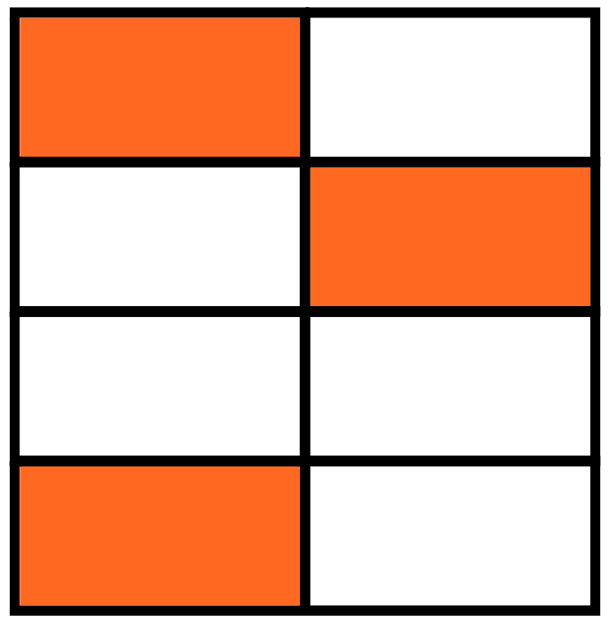
Here, the rectangle is divided into 8 equal parts (so the denominator of the fraction is 8). If we look at those parts that are white, there's 5 of them so 5/8 of the rectangle is white.
Equivalent Fractions
One fraction is equivalent to another when it represents the same part of a whole.
Eg. 1/2 = 2/4 = 5/10 because in each case, the fraction represents a half of a whole.
Multiplying the numerator and denominator of a fraction by the same number will produce an equivalent fraction.
Similarly, dividing the numerator and denominator of a fraction by the same number will produce an equivalent fraction.
Another name for dividing the numerator and denominator by the same number is Simplifying.
4/6 = 2/3 (top and bottom have been divided by 2)
4/6 = 12/18 (top and bottom have been multiplied by 3)
2/3, 4/6 and 12/18 are Equivalent Fractions.
When the numerator (top) and denominator (bottom) can't be divided by the same number, the fraction is in its Simplest Terms.
Writing as a Fraction
To write one number as a fraction of another, put the first number on top of the fraction and the second number below.
Once you've made the fraction, you may be able to simplify it by dividing top and bottom (numerator and denominator) by the same amount.
Improper Fractions
An Improper Fraction is basically one where the top part is larger than the bottom
6/5 and 100/7 are Improper Fractions
Mixed Numbers
A Mixed Number is a combination of a whole number and a proper fraction (a proper fraction is one where the top part is smaller than the bottom part)
1 3/4 and 5 18/19 are Mixed Numbers
To convert an Improper Fraction to a Mixed Number, divide the numerator (top part) by the denominator (bottom part). This gives the whole number part of the Mixed Number. The remainder goes over the original denominator for the fractional part.
To convert a Mixed Number to an Improper Fraction, multiply the whole number part by the denominator (bottom) of the fraction, add the numerator (top) of the fraction to it and put the total over the denominator.
Adding and Subtracting Fractions
Fractions can be added and subtracted like any other numbers, they just require a bit more care.
When the denominator is the same for each fraction, just carry out the arithmetic on the numerators.
So, 5/8 - 3/8 = (5-3)/8 = 2/8
Then, once you've done that, see if the fraction can be Simplified.
To do this, find a number that divides into the numerator and denominator.
2 divides into 2 and 8 so, the fraction becomes: 1/4
When the denominators are different, you can convert them to equivalent fractions with the same denominators and then proceed as above.
For example, if you're asked to do the sum 4/5 + 2/3 first find a number that 5 and 3 divide into, 15, and then convert both fractions to have 15 as their denominator.
4/5 = 12/15 and 2/3 = 10/15 so the sum becomes:
12/15 + 10/15 = 22/15.
Convert to a mixed number for the answer.
✏️Example
What is 2/5 of £60?
✅Solution
Multiply the 2 by 60 to get 120 then divide by 5 to get 24. Remember to add the £ in your answer.
You can check by putting 24/60. Divide top and bottom by 12 to get 2/5.
✏️Example
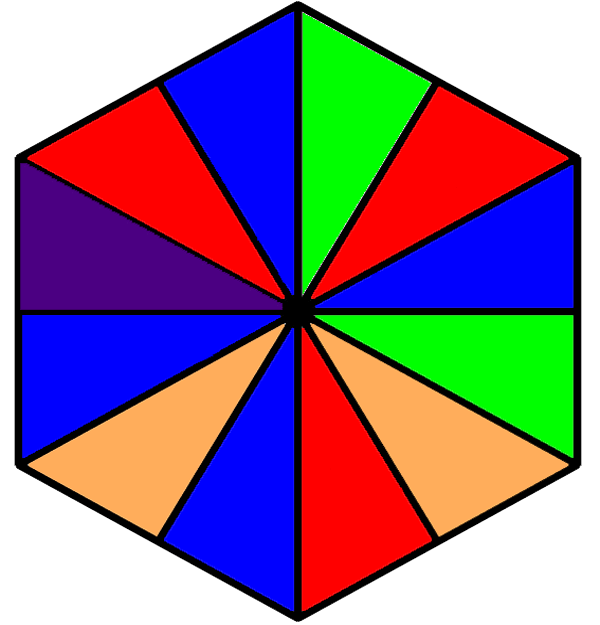
What fraction of the hexagon is coloured red?
Diagram
✅Solution
Count the total number of parts, 12. Now count those coloured red, 3.
So, the fraction coloured red is 3/12. Divide top and bottom by 3 for the answer, 1/4
✏️Example
Which fraction with a numerator of 30 is equivalent to 5/6?
✅Solution
The numerator is the top part of the fraction. 30 = 5 x 6. So, if we've multiplied the top by 6, we need to multiply the bottom by 6 too to form an equivalent fraction.
So, 5/6 is equivalent to 30/36
✏️Example
What fraction is 12cm of 30cm?
✅Solution
Write the fraction as 12/30.
Divide top and bottom by 6 to get 2/5
✏️Example
Convert 7/5 to a Mixed Number
✅Solution
7 ÷ 5 = 1 remainder 2 so the answer is 1 2/5
✏️Example
Convert 4 3/7 to an Improper Fraction
✅Solution
4 x 7 = 28. 28 + 3 = 31 so the answer is 31/7
✏️Example
Work out 5/6 - 1/6 leaving your answers in its simplest form.
✅Solution
The denominators are the same so the answer is (5-1)/6
ie. 4/6 which cancels to 2/3
✏️Example
Work out 2/7 + 1/4 giving your answers in its simplest form.
✅Solution
First find a number that both 7 and 4 divide into. 28 is the smallest such number.
Convert the fractions to be over 28 so the sum becomes:
8/28 + 7/28 = 15/28