11+ NVR: How to Solve Cube Net Questions
A step-by-step guide to solving 11+ non-verbal reasoning cube net questions using three reliable strategies: repositioning faces, opposites and rotating faces.
Why Cube Nets Feel So Hard
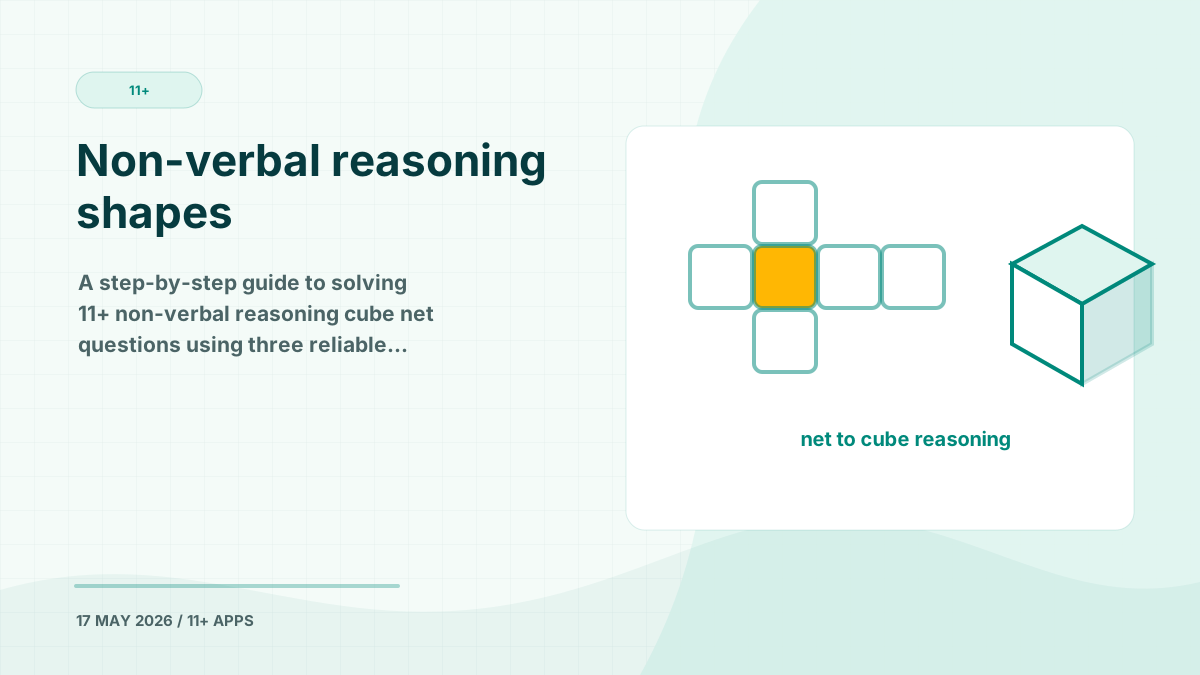
Cube net questions are one of the most feared question types in 11+ non-verbal reasoning. Children are shown a flat arrangement of six squares and asked to choose which of several finished cubes correctly represents the folded net. Without a clear method, it can feel like pure guesswork.
The good news is that you do not need an exceptional mind’s-eye to solve these questions. With three simple strategies and a bit of deduction, almost every cube net question becomes solvable — even the horrible-looking ones.
Tip: Before doing any paper practice, build two or three nets in real life. Draw them on squared paper, cut them out, and fold them. The physical experience of folding rapidly improves your child’s ability to visualise the process on paper.
The Three Core Strategies
| Strategy | What It Does | When to Use It |
|---|---|---|
| Repositioning faces | Redraw a square in a new location on the net so two faces can be compared more easily | When you need to see how two specific faces interact after folding |
| Rule of opposites | Identify which faces will end up opposite each other on the finished cube | When the net has clear pairs of faces two squares apart |
| Rotating side faces | Roll an “outside” square around the central spine, rotating it 90° each time | When a detail on a side face needs to be compared with a non-adjacent face |
These three tools work together. Most questions can be solved by elimination — knocking out four wrong answers — rather than by fully folding the cube in your head.
Strategy 1: Repositioning Faces
When a face is connected to the net at an awkward spot, you can redraw it in a more useful position. For example, if a square is attached at the very top of the net, you can imagine moving it to the bottom instead. When folded, those two locations are equivalent — they meet the same neighbouring face.
This trick is especially helpful when you want to see how a small detail (a triangle, a line, a semicircle) lines up with the face directly below or beside it. By redrawing the square in a neighbouring position, you can immediately spot whether the answer options match.
Did you know? Cube nets have eleven distinct possible shapes. The familiar cross-shaped net is just one of them — knowing this helps children stay calm when they see an unusual-looking layout in the exam.
Strategy 2: The Rule of Opposites
This is the most powerful elimination tool in cube net questions. The rule is simple:
- Two squares that are two apart along a straight line on the net will always end up on opposite faces of the folded cube.
- Opposite faces can never touch in the finished cube.
So if you can identify a pair of opposite faces on the net, you can immediately eliminate any answer option that shows those two faces next to each other.
For a net with a long spine of four squares, you can usually find multiple pairs of opposites:
- The first and third squares along the spine are opposite.
- The second and fourth squares along the spine are opposite.
- The two side-flaps that come off the spine are also opposite to each other (they become the ends of the cube).
A single question can often be reduced from five options to one or two using opposites alone.
Strategy 3: Rotating Side Faces
The third strategy is the trickiest to picture but extremely useful. Imagine a square that sticks out from one side of the net. When the cube is folded, the edges next to that square will all touch each other in turn. This means you can redraw that side face in a new position along the spine — as long as you rotate the design on it by 90° each time you move it.
Picture it as rolling the square up the side of the cube. Every time it moves to a new position, its contents rotate a quarter turn. Once you redraw the face right next to the area you are interested in, it becomes far easier to see whether the answer options match.
Tip: When two answer options look identical to each other (just rotated), they must both be wrong. Multiple-choice questions can only have one correct answer, so identical options eliminate themselves.
Putting It All Together: Deduction Beats Visualisation
The biggest mindset shift for children is this: you do not need to mentally fold the cube. You just need to eliminate the wrong answers.
A reliable order of attack looks like this:
- Scan for opposites. Find pairs of faces on the net that must be opposite. Cross off any answer showing them adjacent.
- Check positional details. Look at where small marks (dots, arrows, semicircles) sit on each face. Are they close to a particular edge? That edge will touch the neighbouring face when folded.
- Reposition or rotate any face you need to in order to compare it directly with a tricky neighbour.
- Pick what’s left. Often only one option survives — and that is your answer, even if you never fully visualised the cube.
This deduction-first approach is the same logic used across other 11+ reasoning topics. For a broader picture, see our guide on non-verbal reasoning tips and practice strategies and the deeper dive in how to tackle nets and cubes.
A Weekly Practice Routine
Cube nets reward steady, hands-on practice rather than last-minute cramming. The routine below works well for children in Years 4 and 5.
| Day | Activity | Time |
|---|---|---|
| Monday | Build one cube net by hand from squared paper | 15 mins |
| Tuesday | Practise 10 cube net questions using the opposites rule | 15 mins |
| Wednesday | Mixed non-verbal reasoning practice (any topic) | 20 mins |
| Thursday | Practise 10 cube net questions focusing on side-face rotation | 15 mins |
| Friday | Timed mini-test: 5 cube net questions in 5 minutes | 10 mins |
| Weekend | Review any wrong answers and discuss the reasoning | 15 mins |
For a wider revision plan that fits cube nets into the bigger picture, our complete guide to 11+ exam preparation sets out a sensible term-by-term approach.
Practise Cube Nets and More with Our 11+ Apps
Cube nets are just one of many non-verbal reasoning question types. Our 11+ Non-Verbal Reasoning app covers them alongside seven other topics, with 210 visual pattern questions across 8 topics including block series, classification, code series, odd one out, and shape sequences. Each question comes with a detailed explanation so your child can learn the reasoning behind every answer, not just the result.
The app is part of our wider suite of seven 11+ apps with over 8,190 questions in total, covering maths, English, vocabulary, verbal reasoning, and non-verbal reasoning. Used together, they give your child consistent daily practice across every part of the exam.
The Bottom Line
Cube net questions look intimidating, but they yield quickly to the right approach. Teach your child to deduce rather than visualise: use the rule of opposites to knock out impossible answers, reposition or rotate faces when a comparison is awkward, and trust the process of elimination. With a few weeks of focused practice, what once felt impossible will start to feel almost routine — and that confidence carries through the rest of the non-verbal reasoning paper too.
Frequently Asked Questions
What is a cube net question in 11+ non-verbal reasoning?
How can my child get better at visualising folded cubes?
What is the rule of opposites in cube net questions?
How long should my child spend on each cube net question in the exam?
Are cube net questions common in the 11+ exam?
Related Apps
Start Practising Today
Download our 11+ exam preparation apps and study with 8,190+ practice questions, mock exams, and detailed explanations.